WhatsApp Bill Payments in India: What You Can Pay, and What You Still Have to Remember
The Short Answer
WhatsApp can now pay your registered household bills in India, and it still cannot remember your deadlines for you. On September 3, 2026 Meta launched Bill Payments in India: a rupee icon at the top of your WhatsApp home screen that reaches 22,722 billers across 30 categories over the Bharat Connect (BBPS) network. Electricity, gas, water, FASTag, insurance, credit cards and loan repayments are all in there. It is a genuinely good feature and it removes real friction.
What it does not do is the other half of the job. Bharat Connect can only present a bill that a registered biller raised, and a great many things with a hard date attached are never invoiced by anyone: a GST return, an advance tax instalment, a rent agreement that expires in March, a passport due for renewal, a landlord who takes rent by UPI. For those, something still has to nudge you. This post maps the line between the two honestly, including the parts where the new feature makes a reminder less necessary.
What Actually Launched, Precisely
The details matter here, because the first wave of coverage got some of them wrong. What Meta announced on September 3, 2026:
- Where it lives. A ₹ icon at the top of the WhatsApp home screen, next to the camera. Not a chatbot, not a channel you message, not a "say hi to a number" flow. Tapping it opens a Payments screen, and bill payments is a section inside that, alongside UPI transfers, mobile recharge and metro tickets.
- What is behind it. Bharat Connect, the network formerly branded BBPS, run by NPCI Bharat BillPay. Meta is not becoming a biller; it is putting a front end on a rail that PhonePe, Google Pay, Paytm and your bank's app have all been using for years.
- How much of it. 22,722 billers across 30 categories, per Meta's own announcement.
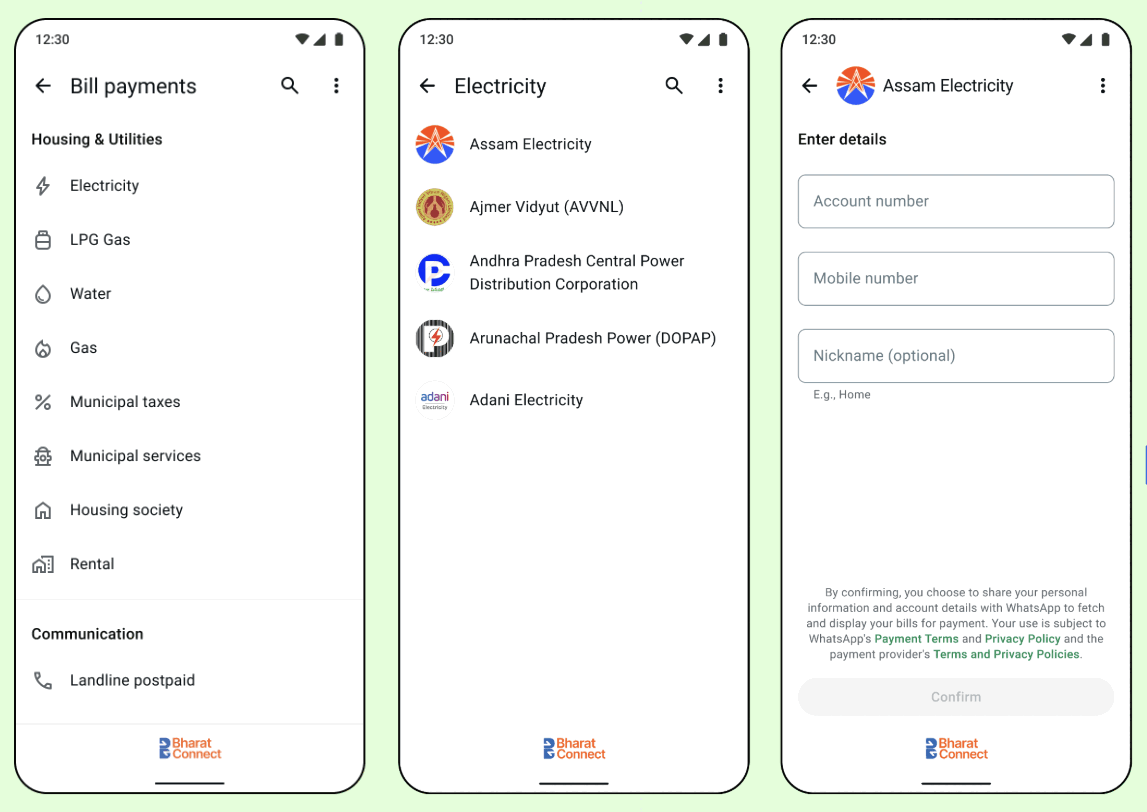
- What you can do there. Find billers, save multiple accounts under one provider, see past payments, see upcoming bills that have been pre-fetched, and pay with the payment mode you choose.
- Who has it. India only, rolling out gradually on Android and iOS over the weeks following the announcement. If you do not see the ₹ icon yet, that is why.
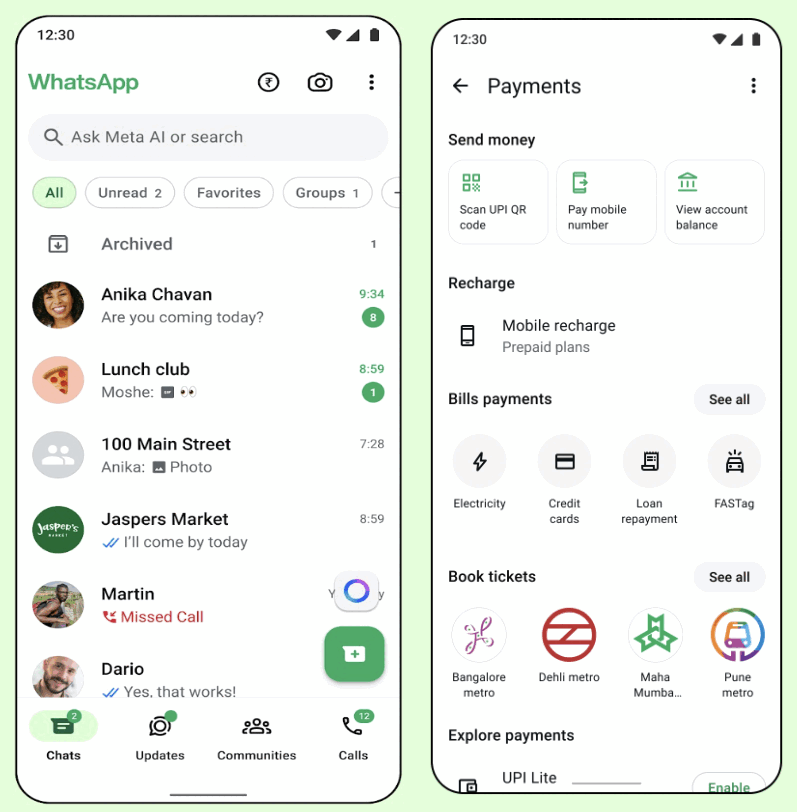
Meta's India head, Arun Srinivas, framed it this way in the announcement: "With Bill payments, we're bringing that same simplicity to one of the most routine tasks in every household. No more juggling apps or tracking multiple due dates."
The first half of that sentence is plainly true. The second half is the interesting one, and it is worth being precise about how far it goes.
What You Can Now Pay Without Leaving WhatsApp
Bharat Connect's category list is broader than most people assume. Through it, WhatsApp Bill Payments reaches, among others:
- Utilities: electricity from state boards and private discoms, piped gas and LPG cylinder booking, municipal water.
- Telecom and media: mobile postpaid and prepaid recharge, landline, broadband, DTH and cable.
- Money: credit card bills, loan repayments, insurance premiums, recurring deposits.
- Home and civic: housing society maintenance, municipal and property taxes, education fees, hospital bills, club memberships.
- Transport: FASTag and NCMC recharge.
If your biller is on that network and you have found them once inside the ₹ tab, the payment part of the job is genuinely solved. There is no honest argument for setting a reminder whose only content is "open an app and type a bill number", when the bill is sitting pre-fetched two taps away in the app your reminder arrives in anyway.
So the useful question is not "is this good?" It is: what is left over?
No app, no account. Save the number, send a message, done.
The Three Gaps It Leaves
Three of them, and they are structural rather than temporary. None of these is a criticism of the feature; they are what a bill payment rail is and is not.
1. It only reaches billers who registered
A category existing on Bharat Connect is not the same as your biller being on it. "Education fees" is a live category, and your child's school may still not be onboarded. "Housing society" is a live category, and your society may still collect maintenance through a UPI ID and a WhatsApp group. "Rent" exists on the network through registered agents, and your landlord almost certainly is not one of them. Coverage per category is uneven, and it is uneven in exactly the places where the money is informal: the tuition teacher, the maid's salary, the milkman, the physiotherapist, the society treasurer. Those payments have due dates too, and no rail is going to present them to you.
2. A great many deadlines are never invoiced at all
This is the bigger one. Bill payments works on a bill: a document a biller raises with an amount and a due date. Enormous parts of adult admin have a hard deadline and no invoice behind them. Nobody sends you a bill for filing GSTR-3B on the 20th. Nobody invoices you for an advance tax instalment on June 15. Nobody raises a document when your rent agreement runs out, your passport expires in six months, your car insurance needs a claim filed within seven days, your appliance warranty ends, or your annual subscription silently auto-renews on a card you meant to cancel. A payment network has nothing to present in any of those cases, because there is nothing to pay yet. There is only a date, and a consequence for missing it.
3. It is a tab you open, not a nudge that arrives
Meta's announcement describes upcoming bills being surfaced inside the bill payments surface, along with pre-fetched bills for one-tap payment. It does not describe a notification that arrives on its own to tell you a due date is close. As of this writing, the upcoming-bills view is something you see when you go and look at it. That is the whole difference between a ledger and a reminder: a ledger is correct and patient, a reminder interrupts you. If Meta adds due-date notifications later, we will update this post and say so.
The Deadlines Nobody Bills You For
A working list of things that have a date, cost real money or real trouble when missed, and will never appear in the ₹ tab. Each of these is one sentence to NagMeLater.
- Tax and filing dates. GSTR-1 on the 11th, GSTR-3B on the 20th, TDS payment by the 7th, advance tax on June 15, September 15, December 15 and March 15, the ITR deadline. We list all of them with a reminder recipe each in the Indian financial year deadlines guide.
- Renewals with no invoice. Passport, driving licence, vehicle fitness and PUC, rent agreement, professional registrations, domain names, an SSL certificate, a gym membership that renews on a card.
- Windows that close. Filing an insurance claim, returning something inside the return period, disputing a credit card charge, using a coupon or a flight credit, an appliance warranty running out.
- Informal money. Rent to a landlord, society maintenance collected by hand, school van fees, staff salaries, the loan you gave a friend that you keep not asking about.
- The check-after-you-pay tasks. Confirming an autopay actually went through, checking whether the electricity units jumped 40 percent this month, verifying a refund landed. Autopay quietly fails on expired cards and low balances, and providers are slow to tell you.
That last one deserves a note. The most common bill-related failure is not forgetting to pay; it is assuming a standing instruction paid it. A monthly two-second "check the power bill actually went through" nag catches the month it did not.
Why This Makes a WhatsApp Reminder Better, Not Worse
Here is the part that genuinely improved last week. Before September 3, a bill reminder in India ended with an app switch: the message arrived on WhatsApp, and you left WhatsApp to go and pay. That gap is where reminders die. You read it, you think "I will do that when I sit down", and you do not.
Now, for a registered biller, the whole loop is one app. The nag arrives as a WhatsApp message at 7pm on the 12th. You tap the ₹ icon at the top of the same screen. The bill is pre-fetched. You pay, you come back, you reply done. No app switch, no password, no hunting for a consumer number.
↺ Next month, the same four steps, none of which leave WhatsApp.
That is a better product for the user than either half alone, and it is the reason we have not rewritten our bill reminder pages to pretend nothing happened. The right reminder text changed slightly, though. It used to be worth saying "pay the electricity bill" and leaving the how to you. It is now worth writing reminders that assume the payment takes ten seconds, which means you can set them tighter to the due date and you have less excuse to snooze them.
The reminders that matter most are still the ones with no bill behind them. Those did not get easier last week, and no payment rail is coming to save them.
Setting the Ones That Are Left
NagMeLater is a contact you message, so each of these is one sentence, sent once, and it repeats forever. Save +1 202 490 9133 and send any of them.
Remind me on the 12th of every month at 7pm to pay the electricity billRemind me on the 20th of every month at 10am to file GSTR-3BRemind me on the 5th of every month at 9am to check last month's autopay went throughRemind me on 15 June every year at 10am to pay the first advance tax instalmentRemind me on 1 February at 9am that the rent agreement expires in MarchRemind me every year on 3 March at 8pm to renew the car insurance before it lapses
When one fires, done logs it, snooze 15 pushes it, and cancel stops the whole series. You can also send a photo of a bill with the caption "remind me on the 5th to pay this", and when the reminder fires the bot quotes your own photo back at you. If you want the full grammar for repeating dates, the recurring reminders guide covers every shape.
One honest note on cost, since we write about this openly: from October 1, 2026 Meta charges businesses for every message they send on the platform, including replies. That is why the bot batches reminders due in the same minute into one message and stops nagging chains nobody answers. It is also why we would rather tell you that WhatsApp now pays your electricity bill than sell you a reminder you no longer need.
Frequently Asked Questions
What is WhatsApp Bill Payments in India?
A bill payment surface inside WhatsApp, announced by Meta on September 3, 2026 and rolling out gradually across India on Android and iOS. You tap the rupee icon at the top of the WhatsApp home screen to find billers, see upcoming and past bills, and pay. It runs on the Bharat Connect (BBPS) network and reaches 22,722 billers across 30 categories.
How do I access bill payments on WhatsApp?
Tap the ₹ icon at the top of your WhatsApp home screen. There is no chatbot to message and no number to say hi to; some early coverage described an older BBPS chatbot flow, not this feature. The rollout is gradual, so if the icon is not there yet it should arrive over the following weeks. It is India only.
Which bills can I pay on WhatsApp?
Anything from a biller registered on Bharat Connect: electricity, piped gas and LPG, water, broadband, DTH and mobile postpaid, credit card bills, loan repayments, insurance premiums, FASTag and NCMC recharge, municipal and property taxes, housing society maintenance, education fees and hospital bills, among 30 categories in total. Coverage inside each category depends on whether your specific biller onboarded.
Does WhatsApp remind me before a bill is due?
Meta's announcement describes bills being pre-fetched and upcoming bills being visible inside the bill payments surface. It does not describe a notification that arrives on its own. In practice that means you see upcoming bills when you open the tab and look, which is different from being interrupted at the right moment. A reminder service still does that part.
Does WhatsApp bill payments replace a bill reminder?
For a registered biller, it removes the app-switching part of the job, which is a real improvement. It does not replace a reminder, for three reasons: billers who never registered on Bharat Connect are not there, deadlines nobody invoices (tax filings, renewals, claim windows, rent to a landlord) have no bill to present, and the upcoming-bills view is something you open rather than something that reaches you.
What can NagMeLater remind me about that WhatsApp bill payments cannot show me?
Anything without an invoice behind it: GST and TDS filing dates, advance tax instalments, the ITR deadline, passport and licence renewals, a rent agreement expiring, insurance claim windows, warranty expiry, subscriptions auto-renewing on a card, rent to a landlord, society dues collected informally, and the check-your-autopay-worked task that catches a failed standing instruction.
Is WhatsApp bill payments available outside India?
No. This launch is India only, built on Bharat Connect, which is India's national bill payment network run by NPCI Bharat BillPay. NagMeLater's reminders work in any country and any timezone, with two current exceptions on WhatsApp's side: Meta's cross-border rules mean our number cannot deliver to Brazil or Indonesia.
Is it safe to pay bills inside WhatsApp?
The payment itself runs on Bharat Connect, the same regulated network behind bill payments in your bank's app, PhonePe and Google Pay, and you choose the payment mode. That is a question for Meta and NPCI rather than for us. NagMeLater never sees or handles any payment: it only stores the text and time of the reminder you set.